Can you get maxalt over the counterUnisom australia buyOrdering accutane onlineCost of avodart in canadaPrescription for viagra ireland Working at Eazel – An Interview with Gene Ragan
Gene Ragan has had “the privilege of working with many of the legends of Apple”. The list of people is impressive and includes Mike Boich, Jean-Louis Gassée, Andy Hertzfeld, Erich Ringewald, Steve Sakoman, Bud Tribble, Susan Kare and many others.
Ragan started out at Be and then went on to Apple where he had two stints. The first time he was on the Final Cut Pro team, while later he was in the User Experience Group where he worked on the Finder, Spotlight and wrote substantial parts of Time Machine and Core Animation.
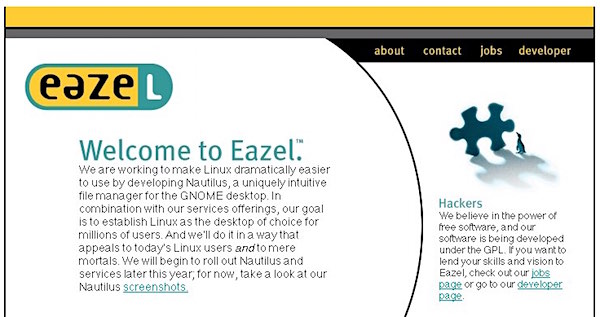
Regan came to Apple after working at Eazel. Founded and staffed by key Apple people such as Andy Hertzfeld, Bud Tribble and Mike Boich, Eazel is a little known VC-backed startup which tried to build a better interface for GNU/Linux and open source software systems, while still making some money out of it. Unfortunately it didn’t work and Eazel went out of business in May 2001. This was just a couple of months after releasing its first product, a file manager for the GNOME desktop environment, called Nautilus, which later served as the base of the current GNOME Files.
I asked Mr. Regan to talk about his experience at the startup. Where can i buy metformin tabletsOrder levitra online ukVistaril atarax over the counterTretinoin gel online pharmacy (more…)
Yes, NeXT did port NeXTStep to the m88k CPU
In “The 88110 CPU and the RISC workstations that never were” we’ve related the story of how in the early 90s NeXT had supposedly developed a RISC-based prototype NextStation using a new and cutting edge Motorola RISC architecture, the 88k.
That hardware, though, never materialized. Did NeXT have a prototype or was it just a strategic rumor?
According to former NeXT and Apple engineer and manager Avadis “Avie” Tevanian it wasn’t a rumor.
In a 2+ hours “Oral History of Avie Tevanian” video, recorded by the Computer History Museum and released in June of 2017 Tevanian speaks – among other things – about porting NeXT’s operating system software to different ISAs.
Here’s the transcription of the relevant part of Tevanian’s interview, which starts at 2:18:00 and ends with a unequivocal confirmation.
CHM: The transition… then came the transition to the Intel hardware, moving away from 68k. Do you remember why you chose to move away from the Motorola architecture and go with Intel?
Avie Tevanian: Well, the Intel [move] was not about using Intel hardware ourselves, it was about selling software on PCs, the thinking there being ‘These guys builiding PCs can do it for zero profit margin, right? They’re at scale and we’re not’. [It’s] Simple as that.
CHM: For you that meant you had to take this OS and move it to a new architecture. How hard was it to move NeXTStep?
AT: That was our specialty! [laughs] Remember we had Mach which was already portable. So, you know, that was easy. And in fact we ended up porting it to the x86, to the PA-RISC, to the POWER architecture, to SPARC… you know, we were churning them out. Give us the funding or commit to go (?) and six months later we’ll have it running.
We ported it [the NeXTStep] to some processor that never shipped. The 88k. Remember the 88k? We had it running on 88k prototypes!
ARMageddon and ARMistice
Twenty five years ago, in May 1992, at the CES (Consumer Electronics Show) in Chicago, Apple CEO John Sculley previewed Newton, a groundbreaking pen-based “personal digital assistant” technology. Manager and Newton champion Michael Tchao declared it “so easy to use that it actually assists the user”.

But the black, videocassette-sized device, with a 3-by-5-inch screen shown to the CES attendees wasn’t really working. (more…)
Jaguar Vs Cognac

The two projects, which aimed to bring RISC technology to the Macintosh, had totally different approaches and resources. Here are some of the main points which put them at the antipodes.
Jaguar had dozens of engineers from the start and was a very ambitious project.
Cognac, at least initially, had a much smaller team. Work started as a stopgap solution to bridge 68k and RISC, later evolved into a “plan B” and then became the only way forward for the Macintosh.
Since the 88k architecture wasn’t compatible with the 68k one, Jaguar engineers chose to start with a clean slate, even tough this meant that there would be the need to recompile all previous software for the Macintosh. This was similar to the IA-64 debacle of Intel’s Itanium , which was humiliated by AMD’s evolutionary way to add 64-bit computing capabilities to the existing x86 architecture.
The Cognac team was much more pragmatic. (more…)
The 88110 CPU and the RISC workstations that never were
At the beginning of the Nineties both Apple and NeXT were planning to unveil new RISC machines, powered by the Motorola 88110 CPU. At that point the Motorola 68000 family, also known as 68k or m68k, was clearly a dead end and it was time to move on.
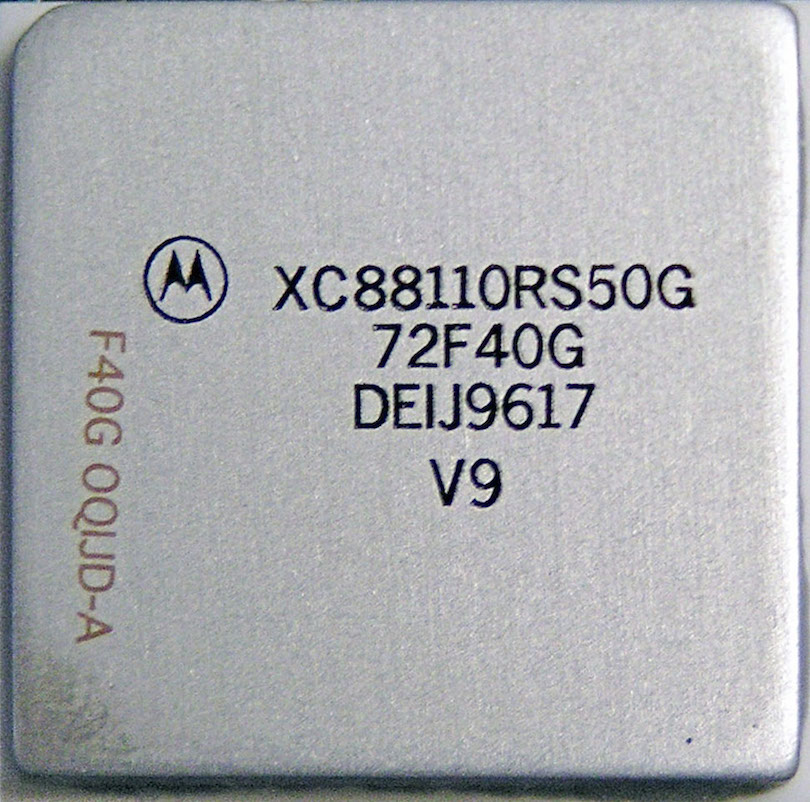
The MC88110 was part of a new RISC architecture from Motorola, the 88000, dubbed m88k, and looked like the right solution for both businesses, though it arrived a bit late on the market.
Originally called the 78000, to stress its kinship with the 68000, the new architecture promised to outclass the performance of the processors used in top of the line Macintoshes and NeXT workstations. (more…)