The Performas

Filed under: Design,Hardware

On the 14th of September, 1992 Apple Computer introduced a new family of Macintosh computers targeting the consumer marketplace. Initially available only in the U.S., the new series of computers were “designed to reach first-time buyers and new users in the home, offering specific solutions for families with school-age children”. Every Macintosh Performa included “enhanced system software, pre-loaded applications [such as ClarisWorks], one year of service and support”, and were to be “distributed in nearly 2,000 consumer retail outlets nationwide”. It was a bold but ultimately unsuccesful move to expand market share by offering an affordable entry into the Macintosh world, rebranding older and low power systems with a new name. The Performas were based on preexisting Macintoshes, although not all of them were exact copies and some even had their own code names.

Macintosh Performa 200 - Photo by Maja VervoortThe initial 1992 Performa family consisted of three models: the Macintosh Performa 200, Macintosh Performa 400 and the Macintosh Performa 600/600 CD. All of them were shipped installed with an optimized version of System 7 called System 7.1P, “designed to make using the Macintosh even easier for first-time computer buyers”.

The Performa 200, code named “Lady Kenmore”, was basically a Macintosh Classic II, released one year after the original and bundled with a 2400/9600 baud fax/modem and extra software. It was discontinued in April 1993, one month after Apple introduced its successor, the Performa 250, which was based on the Macintosh Color Classic.

The Performa 400 was a lowly Macintosh LC II, originally released six months before, in March. Bundled with several different hard drives and software, and rereleased in four variants as the Performa 400, 405, 410, and 430, it unfortunately had the same shortcomings of the LC II, i.e. the LC’s 16-bit data path, which crippled the speed of the relatively fast 16 MHz 68030 processor.

The Performas 600 and 600CD had the look and were based on the motherboard of the Macintosh IIvi but were released a bit later in the consumer market, and sported the IIvx’s 68030 32 MHz processor. The Performa 600 CD were among the first Macintoshes with an internal CD-ROM drive which could read data, play audio discs and also supported Kodak’s Photo CD technology.

The last batch of Performas was introduced in 1996 and discontinued during 1997 and early 1998. Among the last ones was also the first and only original model ever released, the Performa 6400, which had a new tower case design. It was Apple’s first consumer-aimed mid-range computer and had optional A/V capabilities: its innards were also used for the Performa 6360.

The Performa 200 picture is © Maja Vervoort, which has kindly authorized the reproduction alongside this text.

Flattr this

Sunday 16 September 2012, 12:18 pm
Tags: , , , , ,
Any comments?

A chat with Jay Elliot

Filed under: Books,People

Jay Elliot has been part of Apple during its first incredible growth, in the early Eighties. He met Steve Jobs in a restaurant and was offered a job, where he became a Senior Vice President
The rest, as they say, is history, and Elliot has chronicled those years and his thoughts about Steve Jobs and Product Marketing in “The Steve Jobs Way”, a book he cowrote with William L. Simon.

Jay Elliot in BolognaI had the chance to speak a bit with him during his promotional tour for the italian edition, which was published by Hoepli.

Stories of Apple: How long were you at Apple?
Jay Elliot: I was at Apple from 1980 to 1986. Late part of 1980 to the late part of 1986.

(more…)

Thursday 08 December 2011, 3:00 pm
Tags: , , , , , ,
Any comments?

Managing interaction – An interview with Bruce Horn

Filed under: People

Bruce Horn’s career started at the Parc where, as a student, he helped in the development of Smalltalk-based various projects.
In 1981 he started working for Apple where, in the next three years, became a key member of the Mac team.
His contributions include the design and implementation of the Resource Manager, the Dialog Manager and the Finder and also of system-level parts of the Macintosh such as the type framework for documents, applications, and clipboard data.

In the late 80s and early 90s he kept on working with Apple, as a consultant, and was with the Advanced Technology Group (ATG) but also worked for Adobe, on a variety of small projects, including a LaserWriter spooler. In the last years he has been working on Natural Language Processing Technologies and is now at Microsoft.

I contacted him as part of my research on the first year of the Mac and he promptly and very generously answered to all of my questions. In the following interview he shared his thoughts on the “computer for the rest of us” and his role at Apple, before and after.

Bruce Horn with Steve WozniakStories of Apple: What are your fondest memories of the work you did on the Macintosh?

Bruce Horn: Working with Andy, Steve Capps, Steve Jobs, Larry and Patti King, Bill Atkinson and the rest of the Mac software team, and Chris Espinosa, Caroline Rose, and the rest of the incredible Publications group. It would take a whole page to list all the amazing people with whom I had the pleasure of working on the Mac.

SoA: Any funny or weird story you were part of or you witnessed?

BH: Many–see Andy’s wonderful book!

SoA: Do you feel the original Mac’s legacy is still present in the current Mac lineup?

BH: Absolutely. The original Mac’s look and feel is largely still there, enhanced dramatically. I believe that the true spirit of the Mac has been maintained and evolved through the years. You can still tell that a Mac is a Mac and not a PC with its unique combination of ease, simplicity, power, and enjoyment of use.

SoA: Nowadays we have GUIs, object oriented programming, networking, laser printers: has the personal computing world finally caught up with PARC?

BH: Yes, in some ways, but not in others. For the most part the Xerox PARC vision as embodied in the original Smalltalk systems has been copied and enhanced, but the essential dynamic nature of Smalltalk–the ability to change the entire Smalltalk system from within itself–is not something that you can easily do in current systems. Of course, the ubiquitous networking, wireless communications, extremely cheap color printing, digital cameras, and so on have surpassed the PARC technologies substantially.

SoA: On folklore.org and in his “Revolution In The valley” book Andy Hertzfeld states that the Finder and its spatial approach wasn’t influenced just by PARC but also by the Architecture Machine group at MIT. Is this true?

BH: From my point of view, my main influences were those from PARC, and specifically from the Learning Research Group–the group that developed Smalltalk, the first overlapping windows, popup menus, modeless editing, and so on. I don’t think that I had much knowledge of the Architecture Machine Group.

SoA: Some years after creating the Finder you worked again at Apple, twice: first on the Newton and later in Apple’s Advanced Technology Group. What stage was the Newton in at the time? Was it still in the form of a big tablet-like device?

BH: The Newton was a small-ish tablet device and was in the very beginnings of its evolution. I was involved in helping to determine what kind of dynamic programming language would be best for the systems programming of the Newton, and produced a report that had recommendations. At the time I thought that one of the best options would have been a streamlined Smalltalk system, since Apple had developed, in cooperation with Xerox, a very nice Smalltalk implementation that we could then leverage for the Newton.
Unfortunately due to political issues this never happened. An alternative programming system based on LISP was developed but was too large and inefficient for the needs of the Newton, so Walter Smith took on the challenge and invented NewtonScript. NewtonScript turned out to be a very interesting language and an excellent fit for the Newton.

SoA: How was working at Apple’s Advanced Technology Group opposed to a “product” such as the Mac? How loose and “pure” was the research conducted there? Was Larry Tesler still in charge? And what do you think about Steve Jobs shutting the ATG down when he returned in 1997?

BH: Working in ATG was a lot of fun; we were able to explore a lot of interesting things that would eventually become part of the Mac OS, but much later. One project I worked on with Tom Bonura and Jim Miller, called LiveDoc, eventually led to features in Apple Mail where certain types of text are recognized (e.g. names, addresses, phone numbers) and become “live”: you can click on an address and get a map, click on a phone number and create a new contact, and so on.

LiveDoc in action

Our implementation was even more comprehensive and integrated into the main text editing component, so it was available everywhere. It is unfortunate that Steve shut down ATG when he came back, but you can’t be critical of the results. Steve saved Apple and we are all happier for it!

SoA: What’s you opinion of the iPhone and its UI?

BH: Just tremendous. I love my iPhone! I’m sure that if I thought about it critically I could think of some improvements, but it is such a joy to use I’ve never spent much time evaluating it critically :-)

SoA: What are you working on now?

BH: Currently I am the Principal Development Manager for Natural Language Processing Technologies at Powerset, which was acquired by Microsoft last year as part of the Live Search group. Our group is responsible for developing fundamental NL technologies for understanding language, such as finite state morphological analysis (part of speech, stemming, etc.); parsing of text; semantic analysis; and a whole range of development and debugging tools to make the process easier.

Some of the real pioneers and leaders in the NLP community are at Powerset, including Ron Kaplan who codeveloped Lexical Functional Grammars, the basis for our parsing technology; Tracy King, who is our lead syntactician and former head of the NL group at PARC; Dick Crouch, our lead semanticist and developer of our semantics framework; Livia Polanyi, one of our lead researchers and developer of a number of groundbreaking concepts in NLP; Martin Van den Berg, one of our semanticists and key architect of our original semantic index; and many others. This group consists of quite a few PARC alumni, so I feel right at home.
While we are part of Live Search, and thus responsible for improving search at Microsoft, our technologies have a wide range of applications, and we hope to leverage them in projects throughout Microsoft.

SoA: You put a lot of work into iFile: what is its current status? Are you still planning to release it? Did you try Mac OS X Finder replacements such as Path Finder?

BH: It’s on the back burner. Working at Powerset is tremendously demanding and I don’t have much time to work on other projects. When I first showed iFile to Steve Jobs in 1999, it was way ahead of its time, but now with specialized apps like iPhoto and iTunes, and enhancements to the Finder like Smart Folders (which I showed Steve as part of my iFile demo), many of the functions of iFile are now available, although not in an integrated fashion.
I don’t think I’ll release iFile as it is. Maybe if I get some free time I’ll figure out what the next great thing is. It might be iFile v2 or it might be something completely different based on largescale distributed computing. Who knows :-)

Pictures are courtesy of Bruce Horn. The Livedoc example is taken from www.miramontes.com


Update: Per Helge Berrefjord has snapped a series of pictures of Horn at the end of the Eighties when he was at the University of Oslo

Thursday 13 January 2011, 6:00 pm
Tags: , , , , , ,
Any comments?

Jack of all Apple trades – Interview with Bill Fernandez

Filed under: Hardware,People,Software

Bill Fernandez todayBill Fernandez describes himself as an “User Interface Architect” but he is much, much more. Being one of the first employees he has contributed immensely to Apple’s growth and development in various areas and has helped in the development of the Apple I, II and of course of the Macintosh.

We contacted him and he graciously and provided us with answers to our questions, covering in the process quite a big chunk of Apple’s history and also revealing interesting tidbits about his contribution to some well-known products, for which we thank him.

Stories of Apple: At Apple you worked as a hardware engineer, software developer, interface designer, project manager. Would you tell us more in detail a bit about all of your various roles?

Bill Fernandez: Shortly after Woz and Jobs incorporated Apple as a formal company they hired me as an Electronic Technician. Initially I worked in the garage of the Jobs family home where Steve’s dad had set up some workbenches for us. Later we moved into our first office on Stevens Creek Boulevard in Cupertino, CA, and then to our first Apple building on Bandley Drive, also in Cupertino. Over that time period I did a wide variety of technical tasks to assist and augment the efforts of the engineers and managers we werer rapidly hiring. For example:

  • I ran a lot of errands.
  • I built a burn-in box for the Apple I circuit boards (we’d put a dozen computer boards in a box that kept them hot while running so as to force any that were likely to fail early in their lives to fail in the first couple of days so we could fix them and insure that they’d be reliable once we shipped them).
  • I drew the first complete schematic of the Apple II on drafting vellum so that we could make blueprint copies for everyone that needed them.
  • When we received the first printed circuit boards for the Apple II, I assembled the first one.
  • I built a burn-in box for the Apple II circuit boards.
  • I modified a TV set to accept direct input from an Apple II.
  • I taught Jobs how to use super glue to attach a speaker to the Apple II base plate (the secret is to use an extremely thin coating of the glue).
  • And lots of other things.

Bill Fernandez signature inside the Mac 128kAfter about a year and a half I left Apple, then returned in October of 1981 to become about the fifteenth member of the Macintosh development team, and stayed at Apple for the next twelve years.
Happily, I was given my old employee number (number 4), and my new title was “Member of Technical Staff”. Again I was a general technical resource and jack-of-all-trades, but this time at a higher level.
My role shifted as the needs of the group evolved. I laid out the floorplan for the first dedicated Macintosh building and coordinated our move into it. I kept the engineering lab stocked with tools, parts, and equipment. I managed a technician.
When we needed someone to oversee the development of the first external disk drive I became the project manager for that product, managing all the engineering work, travelling to Japan to work with Sony, working with the plastic molding company and so forth.
(more…)

Wednesday 12 January 2011, 6:00 pm
Tags: , , , , ,
1 comment

A history of innovation – An interview with Andy Hertzfeld

Filed under: People,Software

Legendary developer, hacker, but also talented storyteller, Andy Hertzfeld was a key member of the Macintosh team throughout the 80s.

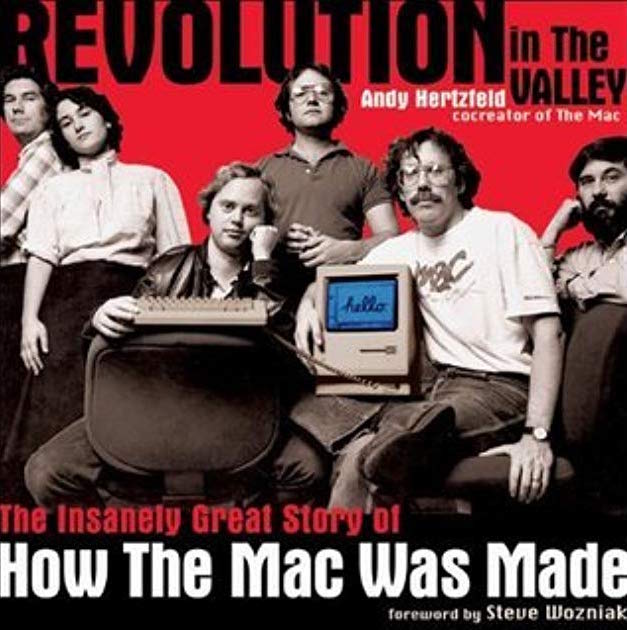
Revolution In The Valley: The Insanely Great Story of How the Mac Was MadeTogether with Bill Atkinson he created the software core around which the computer “for the rest of us” revolved. Also very important was his enthusiasm in involving other creative people (among them, Susan Kare) to the team and last but not least his tireless chronicling -even when working for other businesses- of the folklore(s) of Apple and The Macintosh.

Since the Macintosh is now 25 we got in touch with Andy, who immediately agreed to answer to our questions on his role and involvement in Apple and other projects throughout the years, for which we thank him immensely.

Stories of Apple: What are your fondest memories of the work you did on the Macintosh?

Andy Hertzfeld: My fondest memory is probably the day of the introduction, which was the culmination of three years of hard work, and the day it finally hit the streets, becoming real to the world at large. But there are plenty of other fond memories, many of which I wrote about in my book (see the story “You Guys Are in Big Trouble” for example).

SoA: Do you feel the original Mac’s legacy is still present in the current Mac lineup?

Hertzfeld con Atkinson, Tribble e JobsAH: Sure, I think the unique spirit of the original Macintosh lives on in the current machines. One obvious reason is Steve Jobs – his strong values imbue the original Macintosh as well as the current ones. But even in the mid-nineties, before Steve returned to Apple, the Macs of the time still had much of the playful, rebellious character of the original.
(more…)

Tuesday 11 January 2011, 5:00 pm
Tags: , , , , ,
2 comments


Based on WordPress and the Conestoga Street theme by Theron Parlin